
What if coral had something to teach us?

Introduction
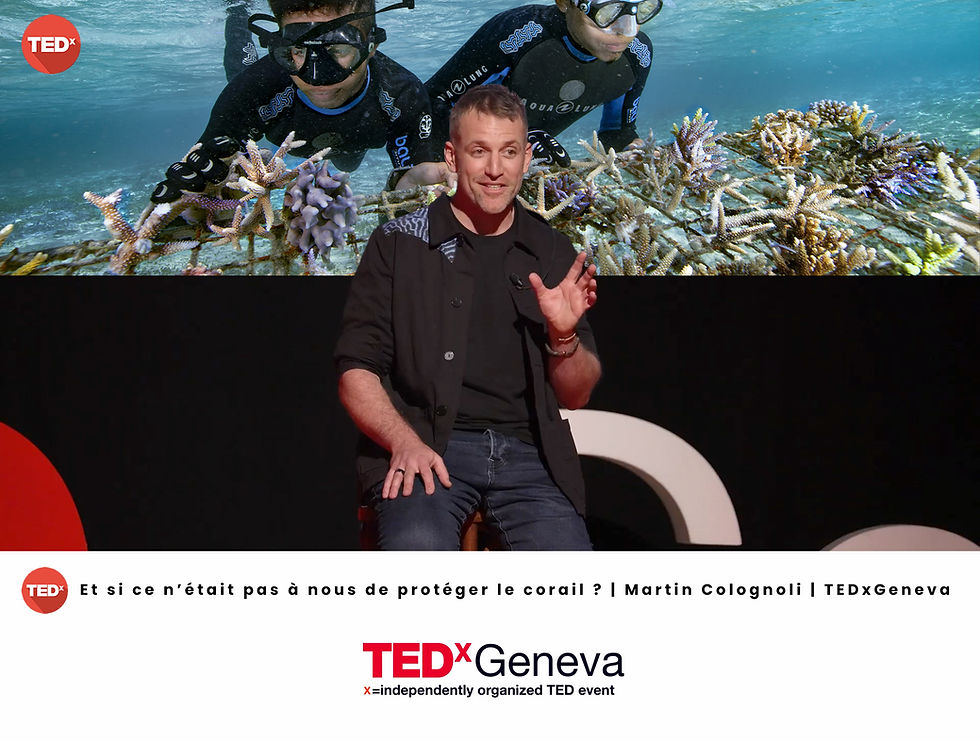
What if it weren't up to us to protect the coral , but rather for the coral to inspire us to rethink our ways of acting? This question, posed by marine biologist and photographer Martin Colognoli during his TEDx Geneva talk, opens up a new horizon: that of a reversal of perspective.
After years spent underwater documenting coral reefs alongside local communities , he realized that coral is not just a victim of climate change. It is also a master of life. An ancient, resilient, symbiotic organism, it carries within it a biological wisdom from which our society could learn.
This article offers a journey at the crossroads of biology, relational ecology, and social transformation. A plunge into a world where life doesn't ask to be saved, but to be listened to.
Coral: the ancient master of life.
A history spanning 500 million years
Coral reefs are among the oldest ecosystems on the planet. Corals have existed for over 500 million years , long before dinosaurs, forests, and mammals. They have survived five mass extinctions , including the one that wiped out 75% of all living species 66 million years ago.
Their secret? A cooperative architecture, a perfectly balanced symbiosis, a continuous adaptation to their environment.
A biological model of interconnection
Coral is a microscopic animal that lives in symbiosis with a single-celled alga , zooxanthellae. The alga produces energy from light, which the coral uses. In exchange, the coral provides the alga with shelter and nutrients.
This partnership is neither hierarchical nor linear. It is a relationship of interdependence , where each element plays a vital role. A silent but essential cooperation.
Faced with a world that values competition, coral offers us another path: that of balance and co-adaptation.

Learning from the reef to rethink our human organizations.
Reefs as models of collective intelligence
Reefs are not simply beautiful. They are complex social structures , built without a leader, without a center. Every polyp, every species, every interaction contributes to the stability of a living whole.
This logic of operation echoes alternative human organizations : decentralized, self-organized, based on cooperation rather than control.
Resilience through diversity
A diverse reef is more resilient. If one species suffers, another can take its place. If a disturbance occurs, the system can adapt.
In our societies and businesses, diversity is not just an ethical issue. It is a driver of stability and innovation . Like coral, we need multiple ways of thinking, skills, and approaches to face the upheavals to come.
Slowness and local anchoring
Corals grow slowly, millimeter by millimeter. They don't adapt by forcing their way forward, but by anchoring themselves over time . They live with their environment, not against it.
In a world that moves too fast, coral reminds us of the importance of taking our time, listening, and being patient. These are precious qualities for building sustainable models.

A transformative experience: immersion in Hatamin.
Living with the fishermen, diving in the coral.
On Hatamin Island, Indonesia, Martin Colognoli lived for several years alongside a fishing community. He worked to restore a degraded coral reef , involving the inhabitants in a participatory project.
But it is less the scientific results than the personal transformation that marks this stay. Living in rhythm with the ocean, observing the reef daily, understanding the invisible links that unite species, humans, and the climate.
The perspective is changing: coral is no longer seen as something to be saved, but as a living being to be listened to .
From conservation to inspiration
This shift in perspective is fundamental. It's no longer just about "protecting nature," but about drawing inspiration from it to transform our own lifestyles.
This approach is part of the regenerative ecology movement: no longer preserving the status quo, but relearning to coexist with living things, drawing inspiration from their forms, rhythms, and balances.
Drawing inspiration from living things to rethink our ways of acting.
Applying the principles of coral to our human systems
How can we apply these principles to our businesses, our communities, our projects? Here are some key points suggested by Martin Colognoli:
Create ecosystems, not machines : think of organizations as reefs, living, adaptable, relational.
Valuing interdependence : no entity functions alone. Success comes from collaboration.
Promote diversity : richness comes from differences, not uniformity.
Take the time : sustainable transformation cannot be decreed, it must be cultivated.
Why ecology is a school of transformation
Far from being a guilt-inducing discourse, this approach offers an inspirational narrative . Coral becomes a poetic and political symbol : it teaches us another way of being in the world.
A gentler, slower, more connected way. More sustainable.

Conclusion
What if coral held the keys to our own resilience?
Rather than seeing it as a victim, let's see it as a living model . It has survived five extinctions. It adapts, cooperates, regenerates. It shows us that strength lies not in domination, but in interconnectedness.
Through his field experience and photographic work, Martin Colognoli invites us to change our perspective . To no longer separate nature and society, but to relearn how to live together.
Coral asks for nothing. But it offers us everything: a lesson in patience, cooperation, and beauty. A path to inventing other futures.
References
Colognoli, M. (2025). TEDx Geneva – What if it wasn't up to us to protect coral? – www.tedxgeneva.net
IPBES (2022). Global Assessment on Biodiversity and Ecosystem Services . www.ipbes.net
Coral Guardian (2023). Symbiosis and reef restoration . www.coralguardian.org
Hagedorn, M. et al. (2019). Coral resilience in the face of climate change . Frontiers in Marine Science.
Capra, F. (1996). The Web of Life: A New Scientific Understanding of Living Systems . Anchor Books.
Glaser, M. et al. (2018). Human-nature relationships in social-ecological systems . Ecology and Society.


